Saturday, September 22, 2012

Back to Eden

I removed a pepper from the fridge today to use in a salad and it was so pretty I felt moved to take a photo of it.  Only when I cut the pepper did I realize there was a small hole in the bottom; and only when I opened the pepper did I realize there was an earwig (our nemesis) inside ...grazing.
My brother-in-law sent us a link to a video the other day, it's about 2 hours long.  Back to Eden chronicles use of wood mulch in organic gardening, among other things.  I'm mentioning it here because there was a bit in the movie about how it's a "good thing" when vegetables have been nibbled by insects--that we should be more concerned if that doesn't happen. Anyway, the pepper was still great, I just cut a little out of it, and said a little prayer of thanks for all the good that has come from our garden this summer.
The salad, one of my favorites for potlucks, was great.  I used up the rest of 2011's frozen corn.
Here's the recipe to alter as needed:
  • 2 cups cooked black beans (I cook a pot beans on weekends in the solar cooker and freeze them in smaller containers)--I rinsed the beans before using them
  • 4 cups frozen corn
  • a red pepper (or green if that's what you have)
  • an onion (whatever you have)
  • 1/4 c olive oil
  • 1/4 c lime juice (or today I had about 1/2 a lime and 1/2 a lemon)
  • salt to taste
  • a few teaspoons of cumin powder
  • a hot pepper, or a few tablespoons of hot pepper sauce
  • sprinkle with some cilantro if desired

Mix it all up at least 1/2 hour before serving.  The frozen corn will be just right and the salad will be cold for your potluck.

Sunday, June 17, 2012

To frack or not to frac, that is the question

Earth flag in crisis!  The winds here have been blowing like the plains of Wyoming or Nebraska.  My recent view of our earth flag caused me to pause and reflect on its symbolic image of care for the planet that sustains us.  We have recently  become involved with others who are concerned about the consequences of under-regulated industry, in this case oil and gas development.  These neighbors were concerned about a gas well which was secretly being "fracked" near their homes.  Some things I had heard about natural gas production were good: mostly, cleaner than coal.  Much of what I heard about hydraulic fracturing of oil wells was bad: pollutes the ground water, pollutes the air, causes earthquakes, uses tons of clean water that cannot be recycled--a massive issue in a bio-region so short on water that farmers can't irrigate crops. 
Here is a link that explains hydraulic fracturing technology and responds to some of the questions and criticism of fracturing 2012.  This 2011 video of Cornell professor Tony Ingraffea is an hour and 45 minutes in length, but contains a lot of information about myths and truths of the "fracking" debate.

The oil and gas industry tells us that methane which causes people to be able to light their tap water on fire is a naturally occurring phenomenon, even when the people whose water quality has been compromised continually testify their water was clean until the point of horizontal drilling using hydraulic fracturing technology.
Colorado has over 50,000 oil and gas wells.   Here is a map showing all permitted wells, producing and not producing.  Wells which are not presently producing may be up for frac-jobs.  Appealing to emotionalism, here is food for thought from the middle of northeast colorado shale country:

Let's hear it for the renewable power of the sun.  Let's hear it for clean water for livestock and people.  Suffice it to say, living on earth is risky.  Farming is radical.  Learn what you can about what others are doing to the land we share, and why. 
Ask yourself who is accountable. 
We are.

Monday, March 26, 2012

Miss Posey Crumbpacker, on Eggs

I was talking to mom on the phone today while I was sitting outside watching the chickens have their time in the sun.  Really I was trying to get them to eat the grass in the raspberries, but they didn't really understand that yet.  We have a bunch of silly chickens.  We got them for eggs, but the recent incursion of 7 who supposedly all were laying and a little more than a year old, prime time, have not proven to be the layers we hoped for.
Anyway, I was talking to mom and mentioned that we had sold some eggs last week. She wondered how much we sold them for and I told her $3 a dozen.  Mom pronounced that "too much".  She said she stopped buying eggs from her neighbor Mildrid because she could get them at the store for 99 cents a dozen. 
I tried to explain to Mom my perspective on how value is more than the price one pays for an item at the store.
I asked her if she knew that in Iowa (where she lives) a few weeks ago they passed a law making it illegal to get a job on a farm with the intention of photographing the operation.  Factory farms are not the farms we all grew up with.  Some people (such as the Humane Society) have made it a mission to expose some of the practices of these operations.  Here is a video which is one of the ones which spurred this Iowa law.
   Now why would they need a law that discourages whistle-blowing of this nature?  As the Iowa family farmer with piglets running past him on another video I saw says, "I have nothing to hide here..."
I'll close now with the hope that Mom calls Mildrid for eggs.  Or at least finds a way to regard where food comes from, in the mix of how food purchasing choices are made.  Miss Posey Crumbpacker, layer of very large eggs, thanks you.

Friday, February 3, 2012

2011 Garden Review

Had friends for dinner this week and Jerry brought some arugula and spinach leaves from his garden. He asked "how our garden was" this year. Funny how easy it is to hesitate with that question. Or maybe forget the bounty we had. Why didn't I say we had our first watermelons ever? And our first canteloupes? We are still enjoying acorn squash.
There is nothing more satisfying and practical than having a store of spinach stashed in the freezer.
We ate fresh salsa this week with our locally grown tomatoes and jalapenos, and tomatoes in both frozen and canned forms for lots of things. (Did not do the sun-dry experiment this year, unfortunately). We have corn and bell peppers in the bag. We have grapes in the jar. We have garlic in the basement. We still have basil in a pot. We have honey in the comb, a process we understand better than we did when we received it. We gave tomatillo salsa and plum jam for Christmas.  Finished the onions, could have used more. Garlic got harvested too late and split, but we are still using it.
A world of carrots never sprouted due to watering issues and planting too late. The boys say they don't want to plant sweet potatoes next year, but seeing this picture makes me think they're silly. Paid almost $1 each for them last week. White potatoes (actually yukon gold) were OK, but not outstanding. Had worm problems for the first time ever. Went through about 9 chickens (give or take) but would not trade any of it. 

"It was an OK year."


 The July 4 Derailer Bike Collective chickens.
Snowball, Rocky, Ginger, and the girl who only lasted a day. 

Monday, August 29, 2011

Rocky Mountain Bee Weed

The bees love this stuff!
Last year we had a single flowering weed, which bloomed late in the summer.  The weed was huge, maybe 7' tall.  It was allowed to remain established because it appeared overnight and was covered with bees--they loved it!   The plant put out seeds in pods--must be a legume, also good for the soil.  There might have been 2000 tiny seeds in each pod. 
I knew as soon as I saw the bees went for it that we needed this plant.  In the spring it came up everywhere--it was easy to tell that this was my plant.  I thinned some out, but left a large bank of what I now know to be "Rocky Mountain Bee Weed". 
Wikipedia informs reader Cleome serrulata is used in the southwestern U.S. as a food, medicine, or dye. It is called waa’ in the Navajo language.  The National Wildlife Refuge Rocky Mountain Arsenal web page tells that bees and insects are attracted to the rich nectar from the blossoms of this native plant, and that the seeds are often consumed by morning doves. Among other uses, the site recommends boiling the leaves as greens, eating the seeds or making them into flour.    I just want all bee-keepers to let some of these grow in their alleys.  If there's any rain at all, you probably won't need to water.
 

Eat what you like and freeze the rest


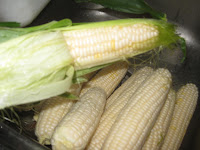
Before August has faded away I will add a garden update for two catbirds, or just to log that we're still doin' it, despite the odds.  On the weekend I made some tomato sauce and froze some corn.  The corn has been magnificent--especially the SUGAR PEARL variety.   
Here's my technique:
  1. Pick corn.
  2. Shuck corn.  Deposit husks immediately into compost.
  3. Wash corn and use the little brush that's made for the strings.  They really work!
  4. Having a good work space is important, although it can be small.  Having a clean work space is important too.  For me this means sweeping the floor and eliminating whatever the contamination of the hour is.
  5. Here's my set up: a banking sheet with a small cutting board to slice the corn off the cob.
  6. Dump the corn in a bowl as needed.  
  7. Freeze in bags, preferably heavy-duty ziploc gallon-sized freezer bags.  Skimping on the plastic can age the corn faster.  Don't forget to label the bags first with date and variety of contents.
  8. Give the cobs to the chickens or the worms.  They'll love you forever.
  9. When it's time to cook, just put whatever amount of corn you want in boiling water enough to heat.  Welcome August all winter long.  
I did an experiment with spreading the corn on a cookie sheet to flash freeze it separately before putting in the bag, but it didn't seem worth the trouble.  If the corn is sticking together, just chisel or gently break off the piece you want from the bag. 

Wednesday, July 6, 2011

Live from Croatia

I realize as I look at this that much has happened here since our last post.  Most notably the Great Memorial Day Chicken Massacre.  Maybe we'll go back or perhaps we'll just go forward from the present.
View from olive grove at  Domigoy and Sanya's house
We've been traveling in the former Yugoslavia, in an effort to understand what happens when war intrudes in life.  Students were supposed to learn about justice and reconciliation, but when we got to this land, our first contact was interested in everything except his extremely personal experiences with the wars of 1992-95.  He had found his peace in living well in a Croatian family home on a map from 1000 years ago, and working an organic vineyard and making wine.  Domigoy and Sanya's place was the epitomy of grace and peace, with good food on top of it.  
So here's what I learned.  Avoid wine with sulfites added.  Domigoy explained that the chemicals used on vineyards are so toxic that they have to "peel the grapes before they use them".  But the tannin in the peels is what makes the wine, so mass producers add other things instead to make it happen.  Needless to say we came back with 2 bottles of their vino sans chemical additives, and a bottle of myrtle grappa "for the stomach".  This post tells a little more about the sulfite issue--that being said, sticking with organic and local products is always a great idea.  We would never buy grapes grown with toxic chemicals.  Similarly we should also avoid the wines made that way.